
PLATO Visual Occlusion Spectacles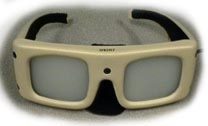

PLATO stands for ”Portable Liquid crystal Apparatus for Tachistoscopic Occlusion”, a spectacle mounted visual occlusion device that allows an experimenter accurately to control the timing of when visual information is presented to an experimental subject.
Uses of PLATO encompass a wide range of topics in visual perception and psychomotor behaviour research, as well as ergonomic testing and evaluation.
Description and Operating Principles
The PLATO lenses are constructed with specially designed liquid crystal cells, which are able to change rapidly from transparent (‘shutter open’) to light scattering (‘shutter closed’). In the Open state, looking through the lenses is like looking through clear glass. In the Closed (occluding) state, the spectacle lenses scatter light and thus take on a translucent milky texture, which prevents the subject from perceiving visual information on the other side. The subject’s eye nevertheless remains illuminated and does not have to re-adapt to light when re-opened.
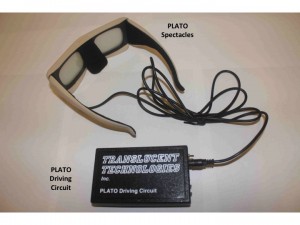
The PLATO lenses are controlled by our custom designed PLATO Driving Circuit (see photo), which enables the lenses for each eye to be controlled independently, with a response time of approximately 4 ms to open and 3 ms to close (with a compensatable delay of ~4 ms). For specific details of the physical and optical characteristics of the PLATO lenses, click here.
The driving circuit is powered by either a 9v battery or an external ac adaptor. It is can either fit into a subject’s shirt pocket or be clipped onto the subject’s belt.
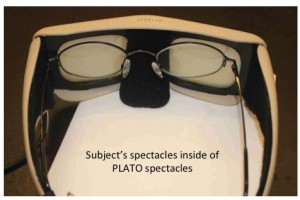
The PLATO spectacles have been designed, out of necessity, with the aim of “one size fits all”. As shown in the accompanying photo, the PLATO frame is large enough to allow a subject to wear his/her own spectacles underneath.
Applications
PLATO spectacles are excellent for a wide variety of applications, encompassing both research and practical interface testing, that require precise rapid control of when visual information is presented to either or both of a subject’s eyes, with minimal light loss. This includes research on visual perception, reading, motion perception, neurological disorders, psychomotor coordination, motor learning, sports psychology, training, conspicuity testing, product recognition, etc. PLATO spectacles are also used frequently for evaluating the mental workload of automobile interfaces, according to NHTSA and SAE guidelines. The spectacles may also be used as a viewing device for alternating field displays in applications such as stereoscopic displays, where it is necessary to separate the input to each eye of the test subject.
Due to their extremely high light transmission factor, the spectacles remain effective for all applications mentioned, even under very low lighting conditions. In addition, the spectacles are constructed without any metal screws, thereby rendering them effective for use in MRI environments.
Please visit our Applications / Publications pages for an extensive (and continually growing) list of how and where our PLATO spectacles have been used.

Purchase
Contact us for purchasing information
Specifications
- 4ms from light scattering to transparent
- 3ms from transparent to light scattering
- At least 80% transmission while open